A refrigerator that freezes everything is nearly always doing one of four things: running at a setpoint lower than it needs, blowing its coldest air straight onto food packed against the vent, chilling a drawer or zone colder than the main cabinet, or acting on a false reading from a worn temperature sensor or control. The first three are yours to fix with a thermometer and a few minutes at the control panel. The last one needs a proper diagnosis. Frozen lettuce and slushy milk will not make anyone ill, but they waste food and electricity, and on a built-in Sub-Zero the cause is usually a single setting or one part rather than anything wrong with the sealed system.
Measure first, then adjust
The number on the display is what the control is aiming for, not proof of what your food is experiencing. Before changing anything, borrow the method the USDA recommends: drop an appliance thermometer into a glass of water near the center of the cabinet, leave the door closed for 5 to 8 hours, and then take the reading. If the water is not sitting between 38 and 40 °F, nudge the control and look again after another 5 to 8 hours. Water changes temperature slowly, so it shows the average your groceries actually live at instead of the spike you would catch with a quick air reading right after opening the door.
Federal energy guidance gives a sensible target. The Department of Energy’s efficiency program suggests 36°F to 40°F for the fresh-food compartment and -5°F to 0°F for the freezer, and it notes that going below 36°F burns extra power without making food last any longer. If your glass of water reads 33 or 34 and the yogurt has ice crystals on top, you have found the problem before calling anyone.
Be patient after any change. Sub-Zero advises giving a unit a full 24 hours to settle at a new setting, and adjusting again sooner tends to chase the temperature up and down without ever landing.
The settings that overcool a Sub-Zero
Sub-Zero controls let you dial temperatures surprisingly low. Classic (CL) and Designer (DET, DEC) refrigerators run from 34° to 42°F, older Classic (BI) and Designer (IT, IC, ID) models from 34° to 45°F, and the freezers from -5° to 5°F. New CL, DET and DEC units arrive with the fresh-food side at 38°F and the frozen side at 0°F, and each press moves them a single degree. A setting near the bottom of that range keeps the air hovering just above freezing, so anything near the back wall or under the outlet will turn solid.
Drawers are the next place to look. On CL, DET and DEC units, Auto Mode holds the refrigerator drawers 2° colder than the main setpoint, though never below 34°F. Manual Mode lets you set them 2° warmer or colder, within 34°F to 42°F. So if the cabinet is at 36 and the drawers are in Auto Mode, your produce is living at 34, which is right where tender greens start to stiffen and frost at the edges.
PRO Series owners have three controls to check, not one. Dual Refrigeration on those units lets the refrigerator, the refrigerator drawer or drawers, and the freezer each hold its own temperature, set from the two touch displays on the grille. A drawer turned down for a party and then forgotten can easily explain a crisper full of icy cucumbers. Undercounter units have their own ranges as well: a Designer Undercounter (DEU) refrigerator spans 34°F to 42°F and a beverage center 34°F to 55°F, so a beverage drawer parked at the floor of its range can freeze cans and burst them.
Where the ice forms tells you why
Pay attention to which food freezes, because the pattern narrows the cause quickly.
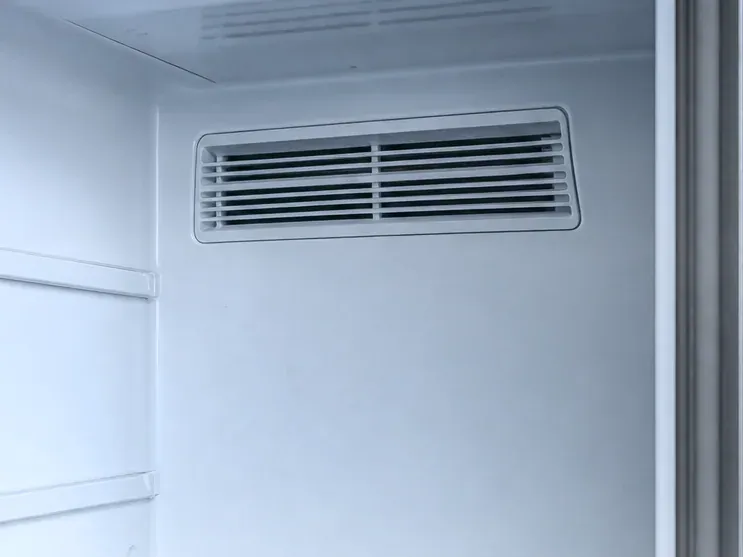
- Only items touching the back wall or sitting in front of the vent: this is airflow. Air leaves the outlet well below the cabinet average, and a carton pushed against it freezes even when the setting is correct. Leave a gap so the cold can spread.
- Only the drawers or one zone: check that zone’s own setting or mode, covered above.
- Everything, top to bottom, even after resetting to 38°F and waiting a day: the control is either getting a false reading or failing to switch the cooling off.
How the cabinet is fed matters too. Many mainstream top-freezer, bottom-freezer and side-by-side refrigerators make all their cold air in the freezer and push a share of it into the fresh-food side through an air damper. If that damper sticks open, the fresh-food side floods with freezer air and the top shelf usually freezes first. Current Sub-Zero full-size refrigerators are built around separate cooling for the fresh-food and freezer sides, so on those a fresh-food section that freezes points to its own sensor or control rather than to air leaking across from the freezer.
Denver garages and cold snaps
One local situation catches people every winter. A spare refrigerator in a detached garage in Highland, Sloan Lake or Platt Park sits in air that often drops below freezing on Denver nights from late fall into spring. A refrigerator can only remove heat; it has no way to warm itself. Once the garage is colder than the fresh-food setpoint, the compressor barely runs and the cabinet drifts toward the outdoor temperature, so drinks and produce freeze while the freezer may actually soften. That is not a fault in the appliance. Move it somewhere heated for the season, or empty the fresh-food side until the weather turns. A built-in Sub-Zero in a heated kitchen will not face this, so if one of those is freezing food, look at settings and sensors instead.
When a part is to blame
If the glass of water still reads in the low 30s a full day after you reset the controls and cleared the vent, the refrigerator is probably acting on bad information. The usual suspects:
- A temperature sensor that has drifted. The control reads this sensor to decide when to stop cooling. One that reports the cabinet as warmer than it really is keeps the compressor going long after the food is cold enough.
- A control board that will not switch off. If a relay on the board sticks closed, the compressor runs nonstop whatever the display claims. You may notice the unit humming constantly and never going quiet.
- On mainstream models, a damper stuck open, as described above.
Typical price ranges for these repairs: a defrost heater, thermostat or sensor job usually runs $290–$670, and an electronic control board $450–$910. Those are ranges rather than quotes; the firm price comes after diagnosis. Our diagnostic visit costs $89, and that $89 is applied to the repair if you decide to go ahead.
It is time to book when the compressor never cycles off, when the display shows a normal setpoint while your thermometer disagrees by several degrees, or when the cabinet ignores a change after 24 hours.
A short checklist before you call
- Stand a thermometer in a cup of water mid-cabinet and check it 5 to 8 hours later.
- Set the refrigerator back to 38°F and the freezer to 0°F.
- Check drawer modes and any separate zone controls.
- Pull food a few inches away from the rear vent and avoid packing shelves wall to wall.
- Wait 24 hours, then measure again.
If the food is still freezing, call (720) 770-4189 or use the booking button on this page. We look after Sub-Zero columns, built-ins and undercounter refrigerators and drawers in Washington Park, Belcaro, Hilltop, Country Club and nearby neighborhoods, and our Sub-Zero freezer repair page covers the freezer side when it stops holding zero. If your trouble is the reverse, a drawer that will not stay cold, start with drawer units that run warm.
Questions
Why is my fridge suddenly freezing everything?
A sudden change usually means a setting got bumped, a drawer mode was switched, or food is now pressed against the cold-air outlet. If none of those apply and a thermometer in water still reads in the low 30s after a full day, a drifting temperature sensor or a control that keeps the compressor running is the likely cause.
Which setting keeps a Sub-Zero fridge from freezing food?
Most households do well leaving the fresh-food side at its original 38°F and the freezer at 0°F. Federal energy guidance suggests 36°F to 40°F for fresh food and -5°F to 0°F for frozen food, and anything under 36°F adds to the power bill without keeping groceries fresher.
Can the fresh-food side freeze food while the freezer seems normal?
Yes. On many mainstream refrigerators the fresh-food side is fed with freezer air through a damper, and a damper stuck open overcools it. On a current Sub-Zero with separate cooling for each side, the fresh-food sensor, the control or a drawer setting is the more likely reason.
How much does it cost to fix a refrigerator that runs too cold?
Diagnosis costs $89, and the fee comes off the repair bill once you approve the work. A sensor or thermostat repair typically falls in the $290–$670 range and an electronic control board in the $450–$910 range, with the firm price given once the fault is confirmed.
Is a fridge that runs too cold a food safety problem?
Not in the way a warm one is, but frozen produce, dairy and sauces lose texture and often turn watery or split when they thaw. The real safety line runs the other way: Sub-Zero states that food kept above 45°F is not safe.